 emc admin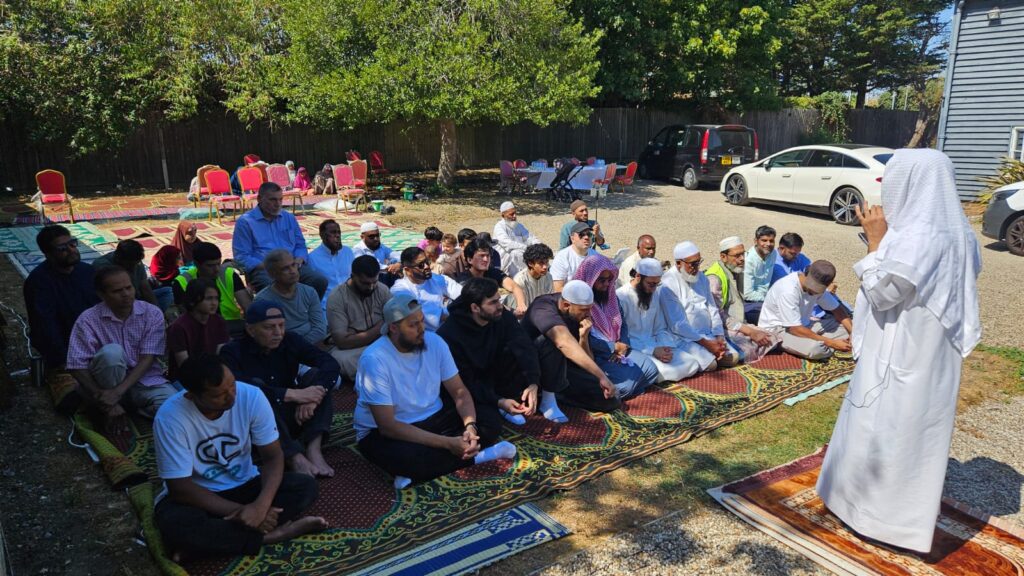
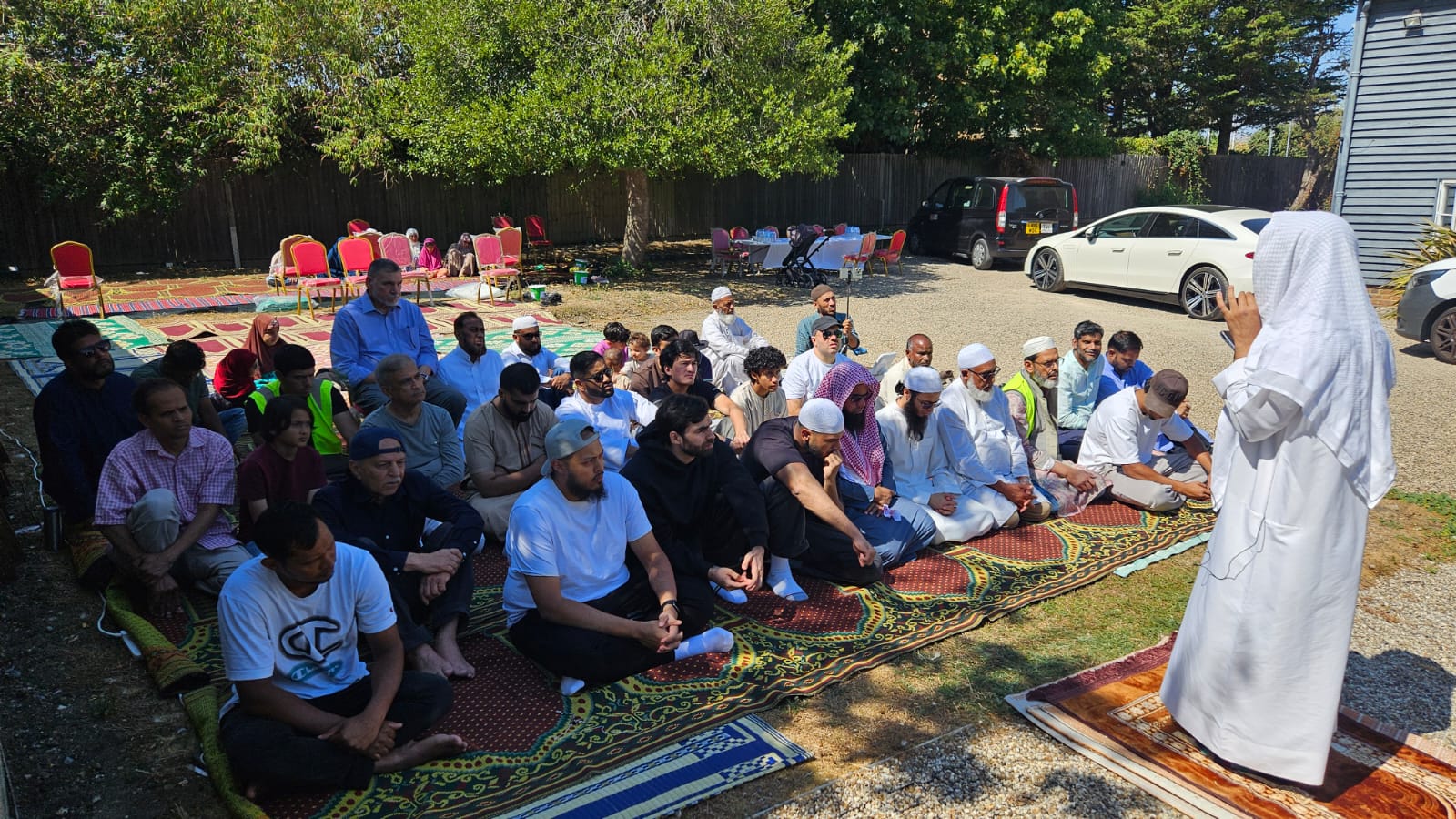
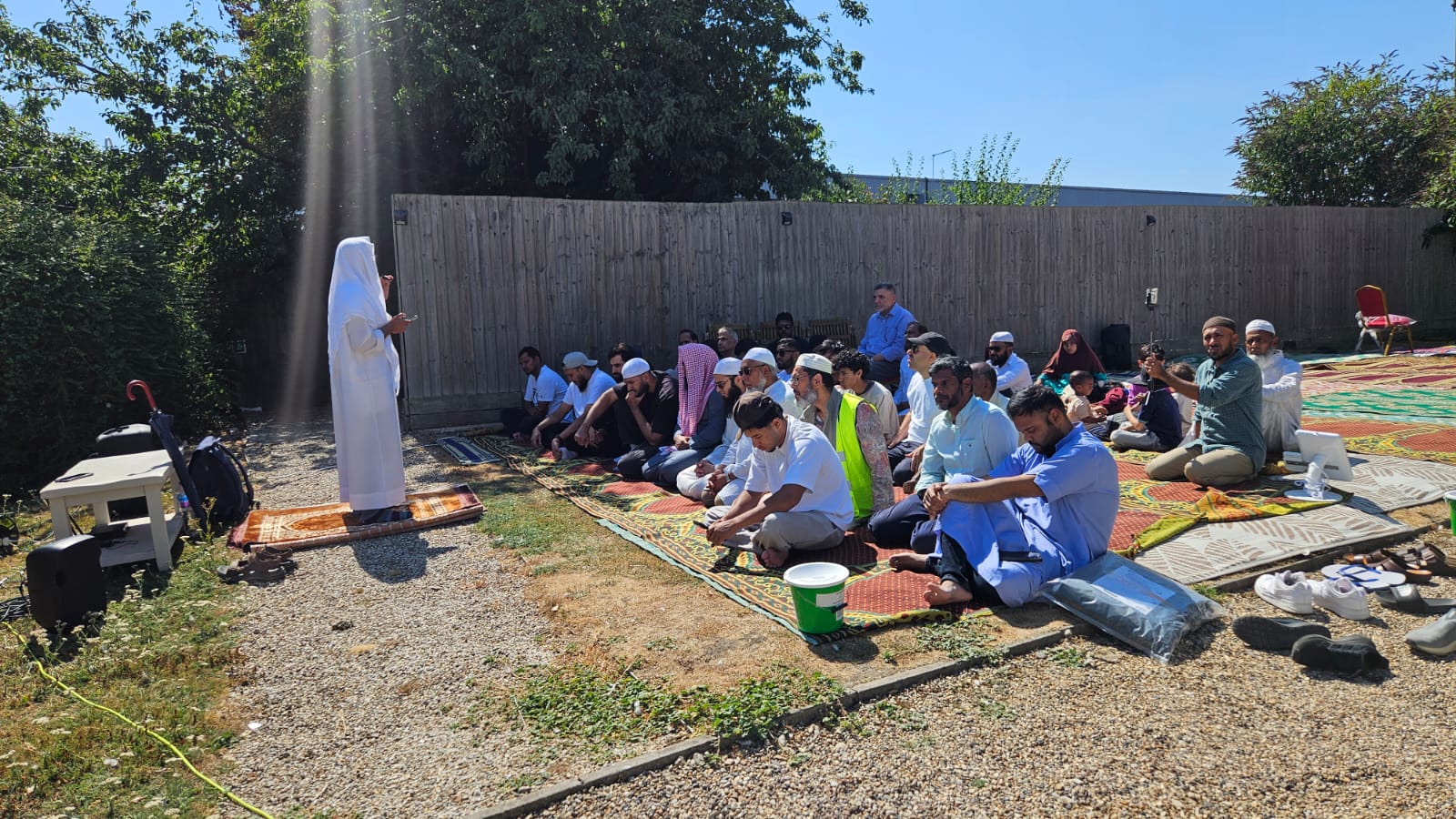
Around forty men, women and children gathered in the open field at Cutton Hall Lane on Tuesday to perform Ṣalāt al-Istisqā’ — the Prophetic prayer seeking rain — as drought grips the East of England.
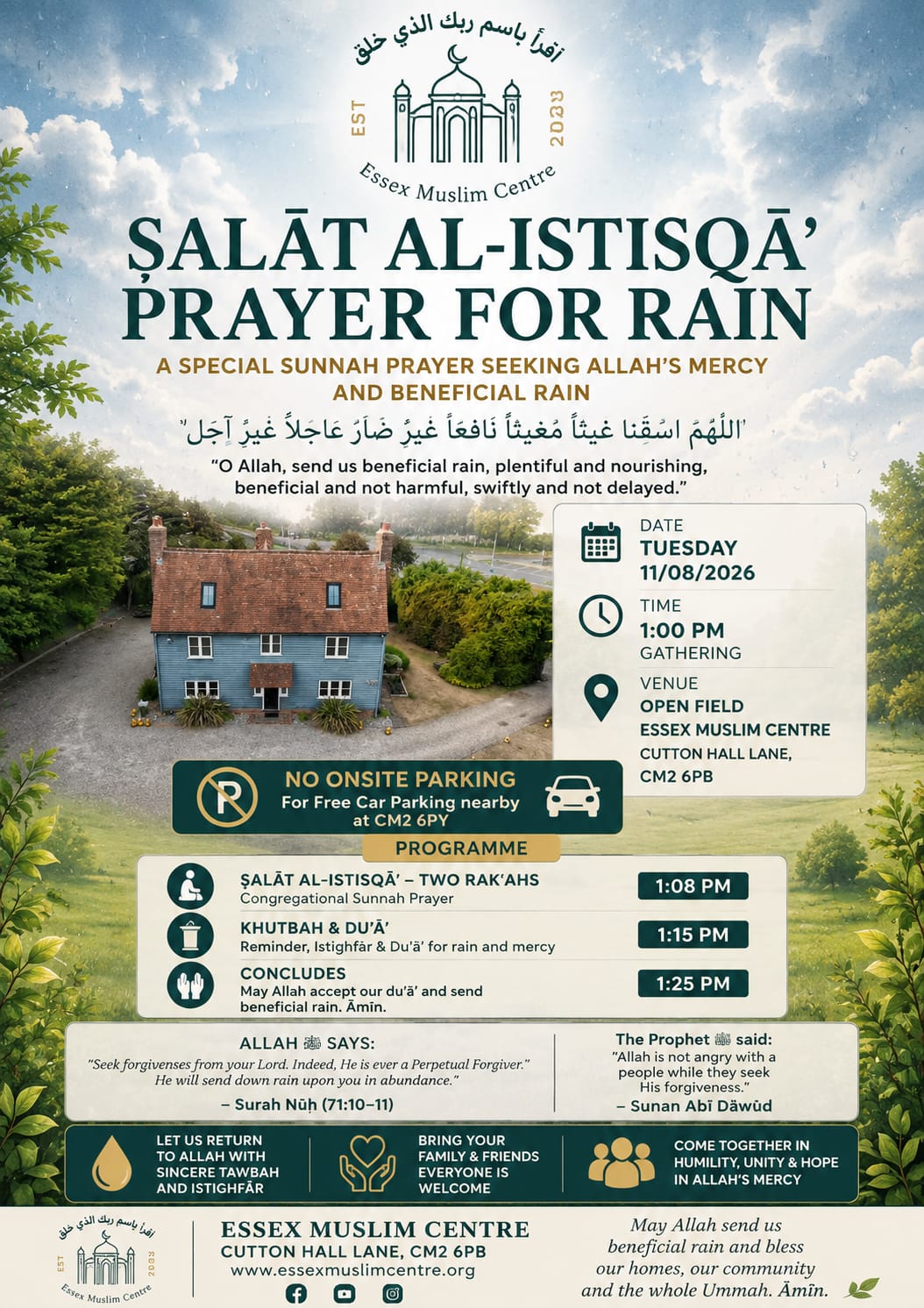
On Tuesday 11 August 2026, around forty people — men, women and children — gathered in the open field beside Essex Muslim Centre on Cutton Hall Lane, Chelmsford. They had come for Ṣalāt al-Istisqā’, the congregational prayer in which Muslims ask God for rain.
The gathering took place against the backdrop of one of the most severe droughts in British history, with a hosepipe ban in force across Anglian Water’s supply area in the East of England. It was the first time this prayer had been held at the Centre. Leading it was Sheikh Mahmood Al Madhani, joined by Sheikh Kashif, Sheikh Muaaz, and many respected elders of the community.
What is Ṣalāt al-Istisqā’?
Istisqā’ means, quite simply, “to seek water”. It is a short prayer of two units — rak’ahs — followed by a khuṭbah (sermon) and du’ā’ (supplication), performed outdoors when rain is withheld and the land is in need. There is nothing elaborate about it. Its whole character is one of humility: a community stepping outside, away from its buildings, to acknowledge that it cannot make rain fall and that it is entirely dependent on its Creator.
The Prophet Muhammad ﷺ performed it, and his practice is recorded in the most rigorously authenticated collections. ʿAbdullāh ibn Zayd al-Māzinī described it plainly: “I saw the Prophet ﷺ on the day he went out to offer the Istisqā’ prayer. He turned his back towards the people and faced the Qiblah and asked Allah for rain. Then he turned his cloak inside out and led us in a two-rak’ah prayer, reciting the Qur’an aloud in them.” (Ṣaḥīḥ al-Bukhārī 1025)
Ibn ʿAbbās recorded the manner of it: the Prophet ﷺ went out mutabadhdhilan, mutawāḍiʿan, mutaḍarriʿan — in plain, everyday clothes, humble and imploring — until he reached the open prayer ground, and “prayed two rak’ahs as he prays on ʿĪd.” (Sunan Abī Dāwūd 1165, graded ḥasan by al-Albānī)
Scholars recognise three forms of istisqā’: supplication on its own; supplication made within the Friday sermon — as when a man stood during the khuṭbah and asked the Prophet ﷺ for rain, and it fell before the congregation dispersed (Ṣaḥīḥ al-Bukhārī, from Anas ibn Mālik); and the formal congregational prayer held in the open, as EMC performed on Tuesday.
The khuṭbah: sin, seeking forgiveness, and rain
Sheikh Mahmood opened by setting the tone. “We have come together,” he told those gathered, “to show Allah that we are in dire need of Him.” This was not a celebration.
Sheikh turned first to a verse from Sūrat al-Mulk — a chapter the Prophet ﷺ encouraged Muslims to read each night — in which God poses a question: “Say: Have you considered — if your water were to sink away, then who could bring you flowing water?” (67:30). Water, he said, is a favour so ordinary that we forget only its Giver can restore it.
Sheikh then drew on Sūrat ash-Shūrā: “And whatever strikes you of disaster — it is for what your hands have earned” (42:30). Here he was careful. It is not for us, he cautioned, to look at any particular catastrophe and declare it a punishment upon a people — citing the Türkiye–Syria earthquake, where the majority who suffered were women and children.
The heart of the sermon was a warning narrated from ʿAbdullāh ibn ʿUmar, in which the Prophet ﷺ named five trials and sought God’s refuge from them (Sunan Ibn Mājah 4019, graded ḥasan). Among them: that when a people withhold the Zakāh of their wealth — the obligatory annual charity of 2.5% — rain is withheld from the sky, and were it not for the animals, it would not fall at all. The others concerned open indecency, cheating in weights and measures, breaking covenants, and leaders ruling unjustly.
But avoiding these things, the Sheikh argued, is not enough. A believer must actively do the opposite: make marriage easy rather than burdensome; spread awareness of barakah (divine blessing) in giving rather than in withholding; go today and repair a broken promise; and accept responsibility as a leader wherever one holds it — in the household, the workplace, the neighbourhood.
Sheikh’s closing appeal was the sharpest point of the sermon, and it was turned inward. It is easy, he said, to point at others. The one who does not pray. The one who cheats. Instead, each person should stand and say: “O Allah, because of my own sins the rain has been withheld — not because of my neighbour, because of me.” Blessing comes, he said, when every individual takes that responsibility upon themselves.
How the day unfolded
The congregation gathered at 1:00pm. Rows were straightened, gaps closed, with space made for the sisters.
At 1:08pm the prayer began. Following the description in the narration of Ibn ʿAbbās — that the Prophet ﷺ prayed “as he prays on ʿĪd” — Sheikh Mahmood led two rak’ahs with additional takbīrs: seven after the opening takbīr in the first unit, and five on rising for the second. He told the congregation beforehand not to worry if they lost count and simply to follow. Scholars have long differed on this detail, some holding that the prayer is two ordinary rak’ahs without extra takbīrs; both practices rest on established scholarly reasoning.
The khuṭbah followed at 1:15pm. Between the two parts of the sermon, the congregation was asked to make istighfār — Astaghfirullāh, “I seek Allah’s forgiveness” — repeated aloud. The Qur’anic basis is direct: “Seek forgiveness of your Lord; indeed He is ever a Perpetual Forgiver. He will send rain upon you in abundance” (Sūrah Nūḥ 71:10–11).
Then attendees turned their garments and hats inside out, following the Prophetic practice of qalb al-ridā’ — the turning of the cloak. The Sheikh explained the wisdom the scholars give for it: it is an outward expression of yaqīn, certainty, that God will likewise turn the situation around. He had brought an umbrella with him to the field for the same reason.
Unlike Jumu’ah or EĪd, the imam turns to face the congregation for the supplication in Istisqā’. Hands were raised, and the gathering answered Āmīn as the Sheikh made the Prophetic du’ā’:
«اللَّهُمَّ اسْقِنَا غَيْثاً مُغِيثاً نَافِعاً غَيْرَ ضَارٍّ عَاجِلاً غَيْرَ آجِلٍ»
Allāhumma asqinā ghaythan mughīthan nāfiʿan ghayra ḍārrin ʿājilan ghayra ājil
“O Allah, send us beneficial rain, plentiful and nourishing, beneficial and not harmful, swiftly and not delayed.”
The du’ā’ asked for rain that would give life to the land, sustain the livestock and crops, and benefit those settled and those travelling. It asked forgiveness for what is concealed and what is declared. It was not, the Sheikh stressed, a prayer for Muslims alone — every living thing needs water, and the supplication was made for all of creation, everywhere.
The gathering concluded at 1:45pm.
A forgotten sunnah
Speaking afterwards, Sheikh Mahmood described Ṣalāt al-Istisqā’ as “a forgotten Sunnah — absolutely forgotten,” and encouraged those present to speak to their imams and to other masājid across Chelmsford and London about reviving it. He also noted that it is not a once-only prayer: it may be performed on any day, and repeated.
Essex Muslim Centre warmly welcomes residents of Chelmsford and the surrounding area, of every background, to its gatherings. Details of future events are published on our website and social media channels.
Event Gallery